
Sunday, February 15, 2009
Sandor Deki Lakatos
For $2 at the local public library book sale I picked up a brand-new copy of a CD by Sandor Deki Lakatos and His Gypsy Band, "Rakoczi Csardas." Well, the guy kicks ass on the fiddle, and the band just cooks for an hour's worth of frenetic Hungarian gypsy tunes. Easy to understand what Brahms and Bartok liked in this stuff, but one also suspects that Mr. Lakatos is not entirely unfamiliar with the classical violin repertoire. When I checked, this album was not available on Amazon, but others by him were. I wonder if he's related to the philosopher... or maybe Lakatos is Hungarian for "Smith"...

Sunday, February 1, 2009
Wall-E
In the cinematic genre of "animated tales of environmental apocalypse that the whole family can enjoy," this is a great one, just a notch below Princess Mononoke. I thought it was at its best in the early scenes back here on earth, but there were plenty of wonderful moments on the Buy-N-Large cruise ship, which presents a quite plausible vision of our human future. The scene in which the infantile, obese, grub-like humans roll and bounce across the pitching deck is a grotesquely funny send-up of Titanic in a movie full of movie quotes, obligatory in clever animated features these days. The robotic love story is touching, and surely you are meant to question whether it is at all a good idea that the humans return to earth, whatever their good intentions. Better to leave it to the humble little machines. Already they seem capable of making better movies than mere humans.
Friday, January 30, 2009
Road Shows, Vol. 1
Our greatest living improviser, Sonny Rollins seems only to have sharpened and deepened his glorious sound as he enters his 79th year. It is the paradox and the beauty of the saxophone that it can simultaneously achieve a ringing metallic intensity, warmth, and fluidity, and no one has perfected the sound the way Sonny has. Road Shows, Vol. I, collects live performances from 1980 to 2007, and the energy and excitement is evident in every cut. The unaccompanied flights of fancy, the high-pressure honking and wailing, the witty musical quotes, it's all there. Not every cut is studio quality... in particular, the piano on "Easy Living," recorded in Warsaw in 1980, may last have been tuned before the War, but by and large the sound is great and the music could not be better.
Sunday, January 25, 2009
Sudden tanoak death
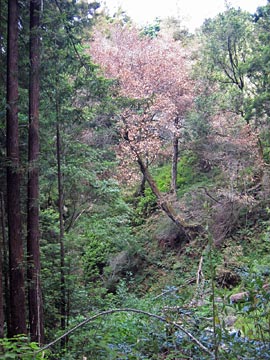 The latest Pacific storm, mild as it was, blew the haze right out of Silicon Valley and greened up the moss and lichens in our foothills... a perfect afternoon for a stroll through beautiful Huddart County Park in Woodside. As in many of our coastal range forests, the tanoak is widespread in Huddart. A variable tree, it is often found at the margins of dense redwood groves, heroically stretching upward to compete for sunlight with the world's tallest species.
The tanoak has tremendous aesthetic value, its rather smooth light gray bark, mottled with patches of moss, providing contrast with the deeply fissured and dark maroon redwood trunks. The tanoak's ovoid, deep green, and slightly serrated leaves remind me a little of the leaves of the American chestnut, a magnificent east-coast beauty that no longer grows beyond head height before succumbing to the chestnut blight.
Our tanoaks now suffer a similar fate, alas--this species apparently the tree most vulnerable to sudden oak death. The accompanying photo, from a UC-Berkeley report, is typical of what one sees throughout Huddart Park. One's sadness at what may eventually be the loss of 100 percent of the tanoaks is compounded by the thought that the sudden oak death organism, Phytophthora ramorum, is ubiquitous in these hills. The notion that its spread may be slowed much by human effort seems wishful thinking to me. If the true oaks prove to be no more resistant than the tanoaks, the California landscape faces drastic and depressing changes ahead.
Tuesday, January 20, 2009
Inauguration
The new president's speech did not disappoint, but the highlights were, most appropriately, Rev. Lowery, and especially Aretha's rendition of "My Country 'Tis of Thee." Breathtaking. I'll never again hear it as a cheesy second-rate rip-off of the Brit national anthem. We own it now.
Update: I guess we already owned it. Some history I should have known.
Update: I guess we already owned it. Some history I should have known.
Friday, January 16, 2009
Free Jazz Classics
In my college days I loved free jazz for its anarchy and noise, rhythmic freedom, silent spaces, and the beautiful contingency of collective improvisation. And I still do... but now I come to find out that the great free jazzers I thought I knew and loved were also secretly composers of intricate structures and melodic themes worthy of Shostakovich, if not Mozart or Richard Rodgers. This and more you will learn from The Vandermark 5's extraordinary two-CD recording, Free Jazz Classics Vols. 1 & 2. The musicianship is first-rate. The compositions reward careful listening, again and again. And they'll give you just the amount of noise you crave.
Monday, January 12, 2009

Friday, December 26, 2008
Great Books, Entry #1
David Arora's Mushrooms Demystified is a labor of love and a masterpiece of its genre, the field guide. As a nerd who enjoys the outdoors and identifying what I encounter there, I own a healthy number of field guides, but this is the only one I would, and frequently do, read for pleasure.
Field guides have much in common with cookbooks, in that they are oriented toward the eager amateur and must therefore be eminently practical but also technically reliable; but for some reason a good cookbook is almost always better written than a good field guide. I suppose it has much to do with the expectation that field guides will have genuine scientific legitimacy, and the convincing gravitas and stuffiness of style that go with it. I must confess off the bat that I cannot vouch for Mr. Arora's bona fides as a mycologist. My gut, as an academic in an unrelated field, tells me that his shortcomings in this regard are likely to be, as we say in economics, "at the margins."
In addition to what appears to be an encyclopedic knowledge of and childlike enthusiasm for wild fungi, Arora has two more things going for him: he is very, very funny, and he is very informative on the cultural uses of fungi, of course as food, but also as dyes, folk medicines, psychoactives, and the like. He is also extremely careful to make sure that you do not repeat the mistake of the elephant king in the Babar story and kill yourself by eating the wrong fungus; at the same time, he is equally intent that you overcome your fungophobia, the result of years of indoctrination (including Babar!) suggesting that every little mushroom you encounter is a dangerous toadstool.
If you do not feel ready to commit to the 900+ pages of the masterpiece itself, you can get a wonderful and useful taste of Arora in his pocket-size All That the Rain Promises, and More..., a little book that any western hiker will enjoy. In my experience it will help you identify, at least to the genus level, 80-90 percent of the mushrooms you encounter in the Bay Area, and introduce you to some of Arora's fellow fungophiles via cute little anecdotes.
The best reason to own these books is that with them, if you keep your eyes and mind wide open, you will gain an appreciation for the extraordinary beauty, diversity, and ecological and cultural significance of wild mushrooms. Opening up a whole new world so large and full of wonder is really what makes any great book great, and it is a rare thing indeed.
Field guides have much in common with cookbooks, in that they are oriented toward the eager amateur and must therefore be eminently practical but also technically reliable; but for some reason a good cookbook is almost always better written than a good field guide. I suppose it has much to do with the expectation that field guides will have genuine scientific legitimacy, and the convincing gravitas and stuffiness of style that go with it. I must confess off the bat that I cannot vouch for Mr. Arora's bona fides as a mycologist. My gut, as an academic in an unrelated field, tells me that his shortcomings in this regard are likely to be, as we say in economics, "at the margins."
In addition to what appears to be an encyclopedic knowledge of and childlike enthusiasm for wild fungi, Arora has two more things going for him: he is very, very funny, and he is very informative on the cultural uses of fungi, of course as food, but also as dyes, folk medicines, psychoactives, and the like. He is also extremely careful to make sure that you do not repeat the mistake of the elephant king in the Babar story and kill yourself by eating the wrong fungus; at the same time, he is equally intent that you overcome your fungophobia, the result of years of indoctrination (including Babar!) suggesting that every little mushroom you encounter is a dangerous toadstool.
If you do not feel ready to commit to the 900+ pages of the masterpiece itself, you can get a wonderful and useful taste of Arora in his pocket-size All That the Rain Promises, and More..., a little book that any western hiker will enjoy. In my experience it will help you identify, at least to the genus level, 80-90 percent of the mushrooms you encounter in the Bay Area, and introduce you to some of Arora's fellow fungophiles via cute little anecdotes.
The best reason to own these books is that with them, if you keep your eyes and mind wide open, you will gain an appreciation for the extraordinary beauty, diversity, and ecological and cultural significance of wild mushrooms. Opening up a whole new world so large and full of wonder is really what makes any great book great, and it is a rare thing indeed.
Subscribe to:
Posts (Atom)